
Features
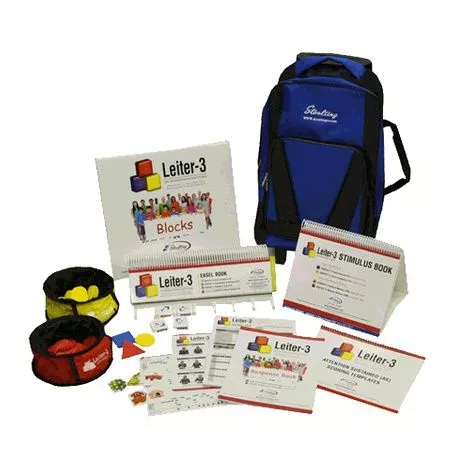
- Stoelting Leitter-3 International Performance Scale Kit contents:
– All Manipulatives (Frame, Blocks, Foam Shapes, Stimulus Cards, Attention Divided Bowls)
– Easel Book
– Stimulus Book
– Scoring Keys
– Administration Gestures Laminate
– Record Forms
– Response Booklets
– Manual
– Timer and a Purple Marker
– Rolling backpack - Lieter-3 has retained the best of the widely used Leiter-R subtests and includes a number of measures
- Age Range: 3 to 75+ years
- Time required: 20 to 45 minutes (Cognitive Scales)
- Uses a refined block and frame format, foam manipulatives for easier manipulation by all subjects
- Completely nonverbal
- Maintains an easy, game like administration throughout the test, which holds interest for a wide range of ages and clinical groups
- Provides improved assessment of fluid reasoning and attention memory
- Provides an IQ score, as well as percentile and age-equivalent scores for each subtest
- Block and frame format for more accurate assessment of autistic individuals
- Decreased number of subtests, increasing overall efficiency and utility of the instrument
- Enhanced data on difficult to assess clinical groups:
– Attention Deficit or Hyperactivity Disorder
– Autism
– Severe Cognitive Delay
– English as a second language (ESL)
– Gifted/Talented
– Severe Hearing Impairment
– Learning Disability
– Severe Motor Delay
– Severe Speech and Language Impairment
More Information
- Designed with Safety in Mind:
– Blocks are lightweight, colorful, non-toxic and choke-safe, with rounded corners, to prevent harm to either the subject or examiner
– The Frame is lightweight, yet durable, without sharp corners
– Foam Pieces are durable and brightly-colored
– Easel and Stimulus Books are laminated for durability and easy clean-up - No Cultural or Language Bias:
– The test is very useful for nonverbal, non-English speaking individuals, as well as those with ADHD, Autism and other communication disorders - Subtests of toelting Leitter-3 International Performance Scale Kit:
Cognitive Scales (Fluid Intelligence):
– The Leiter-3 emphasizes fluid intelligence, the truest measure of an individuals innate cognitive abilities
-Â This makes more accurate and fair, since IQ is not significantly influenced by the individuals educational, social and family experience
– Sequential Order (SO)
– Form Completion (FC)
– Classification and Analogies (CA)
– Figure Ground (FG)
Attention and Memory Scales:
– Attention and Memory subtests enhance interpretation of the global IQ score, by providing valuable diagnostic indicators regarding the score on the Cognitive portion of the Leiter-3
-Â They also distinguish individuals with ADHD, LD or neuropsychological impairments, from typically-functioning individuals
– Forward Memory (FM)
– Attention Sustained (AS)
– Reverse Memory (RM)
– Nonverbal Stroop (NS)
– Attention Divided (AD)
Examiner Rating Scale:
– The Social-Emotional Examiner Rating Scale gathers information about the individuals
-Â Attention
– Organization Skills
– Impulse Control
– Activity Level
– Anxiety
– Energy and Feelings
– Mood Regulation
– Sociability
– Sensory Reactivity - Scoring:
– The Leiter-3 provides individual subtest, and numerous composite scores, that measure intelligence and discrete ability areas
– These scores identify strengths and weaknesses in individual skills, as well as skill sets
– Percentile and age-equivalent scores are provided
– Growth Scores are provided for all domains, enabling professionals to measure small, but important, cognitive shifts within a skill set, particularly important for children cognitive disabilities
– Tracking these shifts allows professionals, educators and parents to see the improvement (growth) across time, irrespective of age-based standard scores - Normative Data:
– Normative data includes more than 1,600 individuals, representative of the most current general population, in terms of ethnicity/race, gender and age
– The normative sample is also diverse in terms of parent/self education level and geographical region - Restricted Use:
– Level B-requires that the user has completed graduate-level courses in tests and measurement at a university or has received equivalent documented training