Features of Dexterity Test Activity Kit
- Useful in predicting success in instrument work which requires the assembling of armatures, miniature parts, assembling of clocks and watches, rapid handwork in the filling of vials, small lathe work, and machine winding
- Helps in assembly line work such as the setting of pivots, registering of gear train assemblies and many other operations required in the production of meters
- The precision of finger movements and concurrently the speed with which a task is carried out is also significant
- It provides accurate and effective measurements for customized treatment
- Aimed to test of both manual and fine dexterity
- Primarily used as a predictive tool wherever rapid manipulation of objects, especially the picking up and placing of small parts, is important
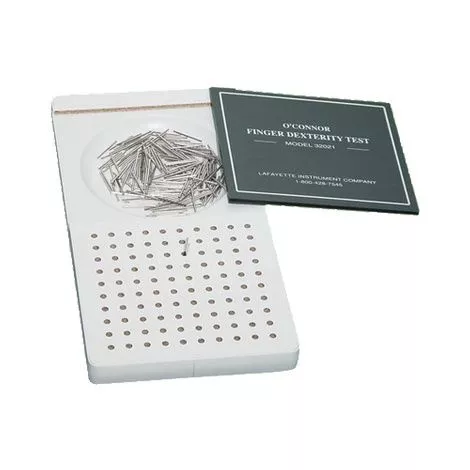
- Requires hand placement of 3 pins per hole, consisting of 100 holes with holes arranged in ten rows and spaced half-inch apart
- 315 Pins one inch long and about 1/16 inch in diameter
- Up to three pins can be inserted in each hole
- Requires tremendous hand dexterity and invaluable hand-eye co-ordination
- Useful for timed evaluation of rapid manipulation of small parts and coordination training
- Includes 11 1/2 x 5 7/8 Formica-topped masonite board with a molded shallow
- Detailed examiners manual features norms to ensure objective testing
Also Available Seperately:
- Lafayette O Connor Tweezer Dexterity Test
- Lafayette Grooved Pegboard Test
- Lafayette Purdue Pegboard Test
How Finger Dexterity Test Works?
The O’Connor Finger Dexterity Test requires hand placement of 3 pins per hole, consisting of 100 holes about 3/16 inches in diameter, holes are arranged in ten rows and spaced 1/2 inch apart. Below are the instructions the subject and examiner should follow while processing the test:
- Subject
- The subject should be seated comfortably at a table measuring approximately 30 inches in height
- Place test pins before the subject about 12” from table’s edge and to the subject’s right if he/she is right-handed
- Place test to left if the subject is left-handed
- Note: Since the rapidity of changing the pins is affected by the condition of the fingernails, it is suggested that all examinees have their fingernails freshly and uniformly clipped.
- Examiner
- The board consists of 100 holes, each hole is large enough to hold three pins
- Pick up three pins at a time and fill the holes, placing three pins in each as fast as you can
- Use only one hand
- Start in the farthest corner working left to right or right to left for left handed subjects
- If started from the corner of subject, their sleeve or finger may catch the pins
- Be sure to fill each row completely before starting the next
- Do not skip around
- There are enough pins in this tray so that if dropped one or two on the floor, still have enough left
- Do not stop to pick them up
- Begin after receiving the command and do not stop until the entire board is filled
- Practice
- Time accurately with a stopwatch, watching the number of seconds required to fill the board
- Record the first fifty holes and the second fifty
- The time taken by the subject to fill up the first five rows and the second five rows should be given and the total time taken for each trial should be worked out
- In the same manner, for all the four trials the time should be worked out
- Thus the meantime for the first half and for the second half of the trials should be worked out
- Total administration time varies, according to a person’s speed, from about 8 to 16 minutes
- Compare the time taken by the students, identify and write the least time taken to complete the experiment
- Finger Dexterity Test User Guide