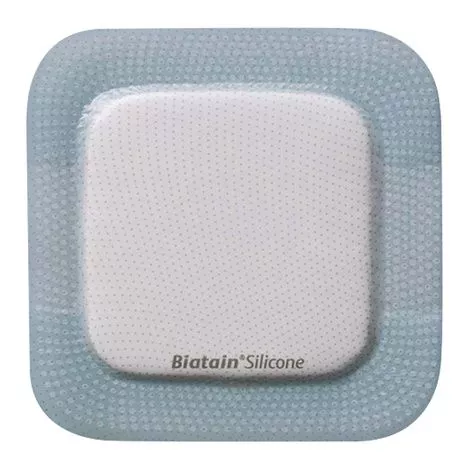
Why choose Biatain Silicone Foam Dressing?
- Non-touch opening: Biatain Silicone has a 3-piece non-touch opening to allow aseptic and easy application and to reduce waste of dressings
- Secure fit: The silicone wound contact layer provides a secure fit to keep the dressing in place while ensuring minimal pain upon removal
- Bacteria and showerproof: The semi-permeable outer film is both bacteria- and shower-proof
- Mode of action: The unique 3D foam absorbs the exudate vertically and together with the lock-away layer it locks away the fluid within its structure, still leaving the wound moist to ensure optimal moist wound healing conditions
- Unique 3D foam for superior absorption: When in contact with exudate, the unique 3D foam of Biatain Silicone conforms to the wound bed. The fluid handling properties of Biatain Silicone ensure optimal control of exudate thus minimizing the risk of maceration and leakage.
- Soft, flexible, and comfortable: The soft and flexible design of Biatain Silicone ensures a close fit to wound and body, and the foam pad at skin level makes Biatain Silicone comfortable to wear – even under compression
- Product composition: It is a soft and conformable polyurethane silicone dressing with a semi-permeable, water – and bacteria-proof top film and a soft silicone adhesive
What to buy with Coloplast Biatain Silicone Dressing
- Coloplast Bedside-Care Body Wash Spray
- Coloplast Baza Moisture Barrier Antifungal Cream
- Coloplast Sea-Clens Wound Cleanser
When to use Coloplast Dressing?
Biatain silicone dressing can be used for a wide range of exuding wounds, including:
- Pressure ulcers
- Leg ulcers
- Second-degree burns
- Non-infected diabetic foot ulcers
- Donor sites
- Skin abrasions
- Post-operative wounds
- Local infection
- Compression therapy
- Systemic infection
Precautions:
- Do not use these foam dressings with oxidizing solutions (e.g. hypochlorite and hydrogen peroxide solutions)
- In case of allergic reactions, please contact Coloplast for further information and directions
- A healthcare professional should frequently inspect and manage infected wounds, diabetic wounds, and wounds that are solely or partially caused by arterial insufficiency in accordance with local standards
- Ensure that any other evaporating solution is completely dried off before dressing application